The global construction landscape is currently witnessing a paradigm shift as engineers seek alternatives to traditional steel to combat the perennial issue of corrosion. Among the most promising innovations, fiberglass concrete reinforcement bars have emerged as a high-performance solution, offering an unparalleled blend of tensile strength and chemical immunity. By replacing oxidizable metals with glass-fiber reinforced polymers, the industry is moving toward a future of "eternal" infrastructure that requires significantly less maintenance.
Understanding the mechanical properties and application versatility of these composite bars is no longer just a technical preference but a strategic necessity for sustainable development. As urban centers expand into coastal regions and harsh industrial zones, the demand for materials that can withstand chloride penetration and sulfate attacks has skyrocketed. This transition is not merely about changing a component; it is about redefining the lifecycle of concrete structures globally.
From reducing the carbon footprint associated with frequent repairs to enhancing the safety of critical infrastructure, the adoption of fiberglass concrete reinforcement bars represents a convergence of material science and environmental stewardship. This guide explores the technical depths, practical advantages, and future trajectories of GFRP (Glass Fiber Reinforced Polymer) technology in modern civil engineering.

Global Relevance of Fiberglass Concrete Reinforcement Bars
On a global scale, the degradation of reinforced concrete due to steel corrosion is a multi-billion dollar problem. According to industry reports and infrastructure assessments aligned with ISO standards, corrosion-related failures account for a significant percentage of bridge and marine structure repairs worldwide. fiberglass concrete reinforcement bars address this critical vulnerability by providing a non-corrosive alternative that remains inert even in the presence of salt and moisture.
The shift toward these composite materials is particularly evident in regions with aggressive environments, such as the coastal cities of Southeast Asia and the salt-treated roads of Northern Europe. By eliminating the risk of rust-induced spalling, these bars extend the service life of structures from 40-50 years to over 100 years, drastically reducing the frequency of disruptive reconstruction projects.
Defining GFRP Reinforcement in Modern Engineering
Fiberglass concrete reinforcement bars, often referred to as GFRP (Glass Fiber Reinforced Polymer) rebars, are composite materials consisting of high-strength glass fibers embedded within a polymer resin matrix. Unlike traditional steel, which relies on a protective oxide layer or coatings to prevent rust, these bars are inherently resistant to corrosion because the glass and resin are chemically stable in alkaline concrete environments.
In simple terms, they function as the "skeleton" of a concrete slab, providing the necessary tensile strength to prevent the concrete from cracking under load. This connection to modern industry is vital; as we build smarter cities, we require materials that are not only strong but also lightweight and electromagnetically neutral, making them ideal for MRI rooms or high-voltage electrical substations.
From a humanitarian perspective, the use of fiberglass concrete reinforcement bars simplifies logistics in remote or disaster-stricken areas. Their lightweight nature—approximately one-fourth the weight of steel—means they can be transported more efficiently and handled without heavy machinery, accelerating the deployment of essential infrastructure.
Core Components of High-Performance Composite Bars
The effectiveness of fiberglass concrete reinforcement bars stems from four key factors: tensile strength, corrosion resistance, electromagnetic neutrality, and thermal stability. The high-strength glass fibers provide the load-bearing capacity, while the polymer matrix protects the fibers and ensures an efficient transfer of stress across the bar.
Durability is the cornerstone of these products. Because these bars do not rust, there is no internal pressure build-up within the concrete, which prevents the characteristic "cracking and peeling" seen in aged sea-walls or parking garages. This inherent stability allows engineers to reduce the amount of concrete cover required, leading to slimmer, more efficient structural designs.
Furthermore, the cost-efficiency of these composite bars is realized through the lens of Life Cycle Cost Analysis (LCCA). While the initial material cost may vary, the total cost of ownership is significantly lower due to the elimination of epoxy coatings, cathodic protection systems, and the massive costs associated with structural rehabilitation every two decades.
Comparative Performance and Scalability Analysis
When comparing GFRP to traditional reinforcement, the most striking difference is the strength-to-weight ratio. fiberglass concrete reinforcement bars offer higher tensile strength than grade 60 steel, allowing for a reduction in dead load for the overall structure. This scalability is crucial for large-scale projects like offshore wind turbine foundations or massive highway overpasses.
Another critical advantage is the lack of electrical and thermal conductivity. In specialized facilities, the use of composite bars prevents interference with sensitive electronic equipment and reduces thermal bridging in energy-efficient buildings, contributing to lower heating and cooling costs.
Comparison of Performance Metrics for Reinforcement Options
Global Applications and Industrial Use Cases
The practical application of fiberglass concrete reinforcement bars spans across diverse sectors. In marine engineering, they are the gold standard for piers, seawalls, and jetties where saltwater exposure would destroy steel in a matter of years. In the transport sector, they are increasingly used in bridge decks and road pavements to eliminate potholes caused by internal rebar corrosion.
Beyond heavy infrastructure, these bars are utilized in residential settings for swimming pools and basement walls. In remote industrial zones, such as mining sites in the Arctic or desert regions, the ease of transport and resistance to extreme temperature fluctuations make GFRP the most reliable choice for rapid construction.
Long-Term Economic and Environmental Value
The value proposition of switching to fiberglass concrete reinforcement bars is deeply rooted in sustainability. Traditional steel production is carbon-intensive; by extending the life of a structure and reducing the need for replacement concrete (which is a major source of CO2), GFRP bars contribute significantly to "Green Building" certifications like LEED.
From a psychological and social angle, these materials instill a sense of trust and safety. Imagine a bridge that doesn't require closure every ten years for structural patching, or a coastal defense system that remains rock-solid against rising sea levels. The reliability of composite materials ensures that public infrastructure serves generations rather than decades.
Logistically, the reduction in weight translates to fewer truck trips to the construction site, reducing fuel consumption and traffic congestion. This ripple effect of efficiency creates a leaner construction process that benefits the contractor, the developer, and the end-user.
Future Innovations in Composite Reinforcement
The future of fiberglass concrete reinforcement bars is moving toward "smart" composites. Researchers are integrating fiber-optic sensors directly into the bars, allowing the structure to "feel" stress or damage in real-time. This digital transformation will enable predictive maintenance, where engineers are alerted to potential issues before they become visible cracks.
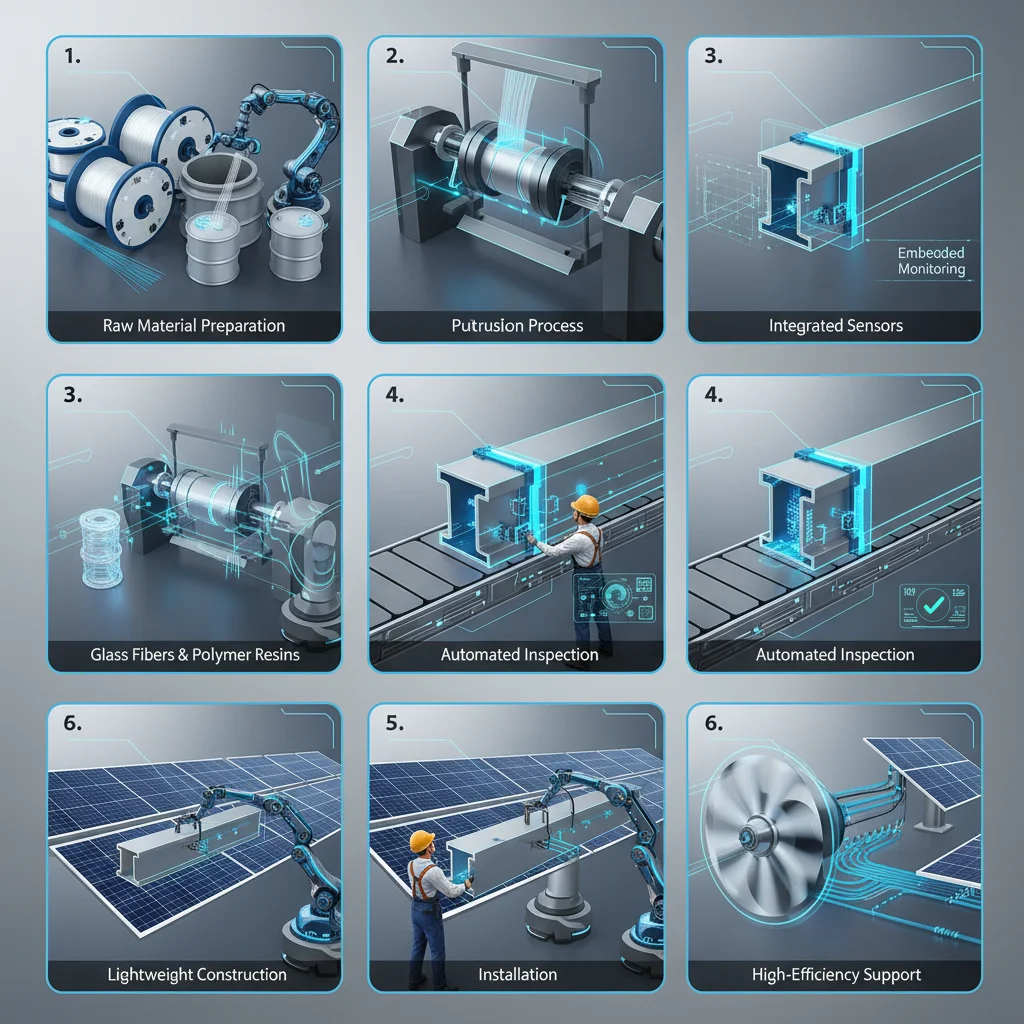
Additionally, the development of bio-resins is reducing the reliance on petroleum-based polymers, making the production of GFRP bars even more eco-friendly. Automation in pultrusion processes is also driving down costs, making high-performance composites accessible for smaller, residential projects.
As global policies shift toward mandatory carbon neutrality, the adoption of these materials will likely be mandated in government-funded infrastructure projects. The synergy between automation, green chemistry, and structural engineering is paving the way for a new era of composite-centric construction.
Comparative Analysis of Reinforcement Material Evolution
| Material Type |
Corrosion Risk |
Service Life |
Maintenance Level |
| Carbon Steel |
Very High |
30-50 Years |
Frequent |
| Epoxy Steel |
Moderate |
40-60 Years |
Periodic |
| GFRP Bars |
Zero |
100+ Years |
Minimal |
| Stainless Steel |
Low |
75-100 Years |
Low |
| Basalt Fiber |
Zero |
80-100 Years |
Minimal |
| Carbon Fiber |
Zero |
100+ Years |
Minimal |
FAQS
No, GFRP bars are completely non-corrosive. Unlike steel, they do not oxidize when exposed to water, salt, or chemicals. This makes them ideal for marine environments and chemical plants where traditional steel would fail rapidly.
In terms of tensile strength, GFRP bars often exceed the strength of standard steel. However, they have a different modulus of elasticity, meaning they are more flexible. Engineers adjust the design to account for this, but the overall structural integrity is often superior in corrosive settings.
Unlike steel, GFRP bars cannot be bent cold on-site because the cured resin would crack. All bends must be pre-manufactured at the factory using a heat-setting process. This encourages better planning and precision in the design phase.
The initial purchase price may be higher in some markets, but the "Life Cycle Cost" is significantly lower. You save money by eliminating expensive corrosion-protection coatings and by avoiding costly structural repairs and replacements over the next 50 years.
Yes, they are widely approved for slabs, walls, and pavements. Because they are non-conductive, they are actually safer for structures containing high-voltage electricity or medical imaging equipment where metal interference must be avoided.
You should specify the required tensile strength, bar diameter, and surface treatment (such as sand-coating for better bonding with concrete). Consulting with a composite specialist ensures the design meets local building codes and performance requirements.
Conclusion
The integration of fiberglass concrete reinforcement bars into modern construction marks a decisive move away from the vulnerabilities of the industrial age toward a more resilient, sustainable future. By combining exceptional tensile strength with a total immunity to corrosion, GFRP technology solves the most expensive problem in civil engineering: the decay of internal reinforcement. From coastal defenses to smart cities, the long-term benefits in durability, reduced maintenance, and environmental impact are undeniable.
As we look forward, the shift toward composite materials will likely accelerate, driven by the dual pressures of climate change and urban growth. We encourage architects, engineers, and developers to embrace these innovations to build infrastructure that is not only functional but enduring. To explore high-performance reinforcement solutions for your next project, visit our website: www.hbztcomposite.com.