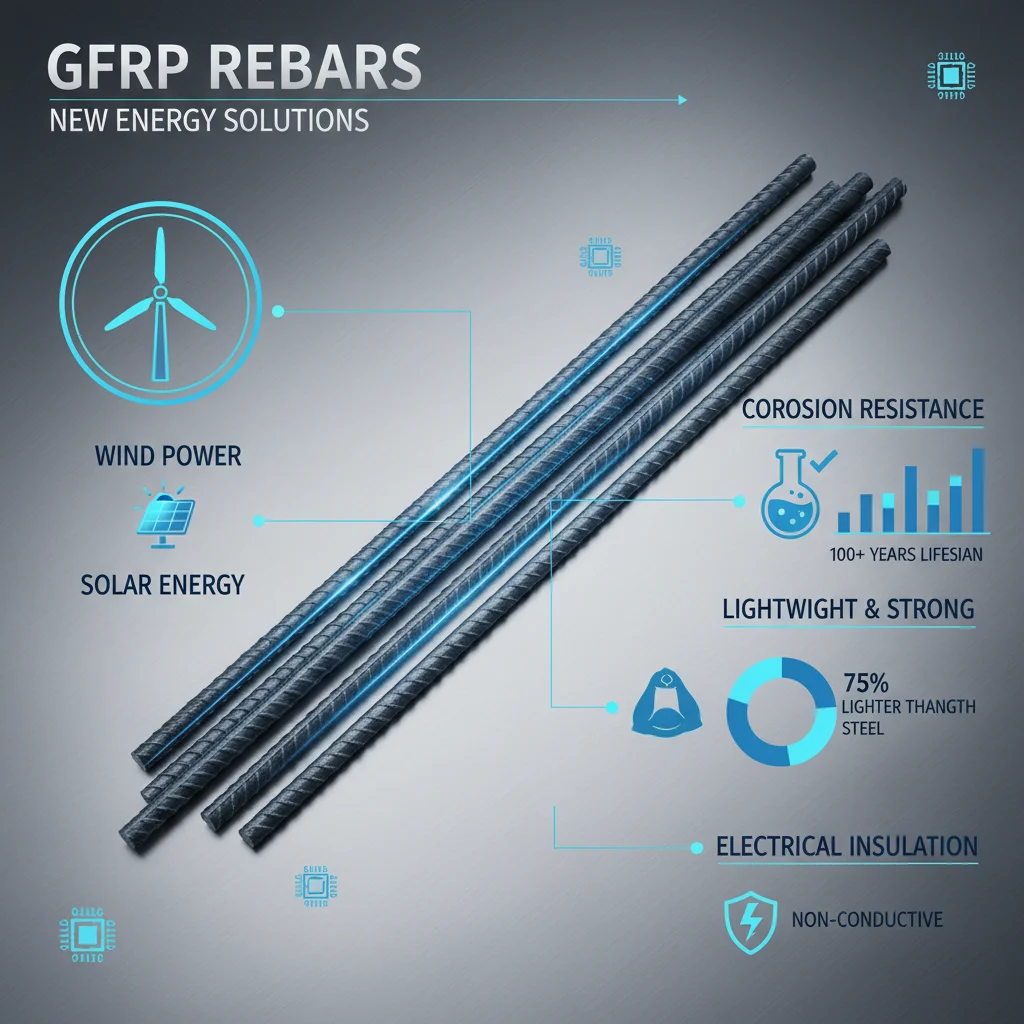
The global construction and industrial sectors are currently undergoing a paradigm shift toward materials that offer greater durability and lower maintenance. In this context, the evolution of gfrp rebar technology and related composite pultrusion methods has provided a critical alternative to traditional steel, addressing the systemic failure of metallic reinforcements in corrosive environments.
As infrastructure ages worldwide, the cost of corrosion-related repairs has reached staggering levels, prompting engineers to seek non-conductive, rust-proof solutions. The application of advanced composite principles—integrating high-strength glass fibers with specialized resin matrices—allows for the creation of structural components that are not only lightweight but virtually immune to chemical erosion.
By leveraging the core strengths of gfrp rebar technology, modern engineering can now implement FRP Three Cavity Angular Extruded Profiles. These profiles apply similar composite reinforcement logic to structural frameworks, ensuring that critical installations in chemical plants and electrical substations maintain their integrity for decades without the need for frequent painting or protective coatings.

The Fundamentals of Composite Structural Logic
At the heart of high-performance structural composites is the synergy between continuous glass fibers and a premium resin matrix. This is the same conceptual foundation found in gfrp rebar technology, where the fibers provide the tensile strength while the resin protects the fibers and transfers the load between them. When applied to angular extruded profiles, this logic results in a material that possesses a high strength-to-weight ratio, allowing for the design of frameworks that are robust yet easy to handle.
These composites are engineered to overcome the inherent weaknesses of metals, specifically the tendency to oxidize in salty or acidic air. By utilizing non-metallic constituents, these profiles ensure dimensional stability and maintain their mechanical properties even under extreme thermal or chemical stress, making them indispensable for modern infrastructure.
Engineering Precision via Pultrusion Processes
Precision pultrusion is the manufacturing cornerstone that allows for the creation of complex shapes like the Three Cavity Angular Profiles. Unlike traditional molding, pultrusion is a continuous process where fibers are pulled through a resin bath and then through a heated die, ensuring that the longitudinal fibers remain perfectly aligned. This alignment is critical for maximizing the axial strength of the profile, mirroring the efficiency seen in high-end gfrp rebar technology.
The consistency of the pultrusion process minimizes internal voids and material waste, resulting in a product with uniform density and predictable mechanical behavior. This predictability is essential for engineers who must calculate load-bearing capacities for industrial racks, conveyor systems, or architectural supports.
Furthermore, the ability to integrate flame retardant options and UV-resistant resins during the pultrusion stage ensures that the final product is tailored for its specific environment. Whether it is a coastal bridge support or an indoor chemical processing frame, the process allows for the exact chemical composition needed to ensure longevity.
The Three-Cavity Design Advantage
The innovation of the three-cavity hollow design is a strategic move to optimize the moment of inertia. By distributing the material further from the neutral axis, these profiles provide significantly higher rigidity and resistance to bending and twisting compared to standard solid profiles, drawing from the same structural efficiency principles used in gfrp rebar technology.
This hollow configuration does not sacrifice strength; instead, it maximizes the strength-to-weight ratio. By reducing the overall mass of the component, installation becomes faster and safer, reducing the reliance on heavy lifting machinery and lowering the overall carbon footprint of the construction process.
Beyond weight reduction, the three-chamber architecture enhances the profile's resistance to compression and buckling. This makes the FRP Three Cavity Angular Profile an ideal choice for long-span installations and suspended structural supports where maintaining a lightweight profile without compromising stability is a primary engineering requirement.
Comparative Performance Metrics
When comparing FRP composites to traditional steel, the differences in operational longevity are stark. Steel requires constant maintenance—painting, galvanizing, and coating—to prevent rust. In contrast, profiles leveraging gfrp rebar technology principles are inherently immune to chemical erosion and rust, drastically reducing the Total Cost of Ownership (TCO) over several decades.
The electrical properties also provide a safety advantage that metal cannot match. Being non-conductive and insulating, these profiles eliminate the risk of electrical arcing in high-voltage environments, providing a natural layer of safety for personnel working in power substations or telecommunication towers.
Comparative Performance Rating: FRP vs Traditional Materials
Industrial Applications and Use Cases
The versatility of FRP Three Cavity Angular Profiles makes them suitable for a wide array of demanding environments. In chemical processing plants, they are used for heavy-duty machinery racks and conveyor systems where exposure to acids and bases would destroy steel within years. The inherent non-conductive nature of these materials, similar to the safety profiles of gfrp rebar technology, makes them the first choice for electrical supports in power substations.
Beyond heavy industry, these profiles are finding increased use in modern architecture and infrastructure. From rust-proof window frames and façade supports in coastal commercial buildings to long-span roofing systems and prefabricated modular walls, the material's ability to be easily cut, drilled, and fastened on-site significantly accelerates project assembly time.
Sustainability and Lifecycle Value
Sustainability in modern manufacturing is no longer optional. The pultrusion process used for these FRP profiles is highly efficient, minimizing material waste and producing consistent quality with a relatively low energy footprint. When combined with the material's low weight, transportation energy is significantly reduced compared to transporting heavy steel beams.
The true environmental and economic value, however, lies in the extended service life. By eliminating the need for frequent painting—which often involves volatile organic compounds (VOCs)—and removing the need for replacement due to rust, the lifecycle environmental impact is drastically lowered.
Investing in these composite materials is a move toward "permanent" infrastructure. The reduced maintenance cycle means fewer disruptions to industrial operations and a more reliable safety profile for the personnel utilizing these frameworks, echoing the long-term stability goals of gfrp rebar technology.
Customization and Future Implementation
Every engineering project has unique requirements, and the flexibility of FRP composites allows for precise customization. We offer adjustable wall thicknesses and cavity sizes to meet specific load-bearing specifications, ensuring that the profile is neither over-engineered (which wastes material) nor under-engineered (which compromises safety).
As we look toward the future, the integration of "smart" resins and carbon fiber hybrids will further enhance the capabilities of these profiles. The trend is moving toward modular, prefabricated systems that can be deployed rapidly in remote industrial zones or post-disaster reconstruction areas, where logistics and labor costs are high.
The shift toward gfrp rebar technology and advanced pultruded profiles represents a broader commitment to innovation and reliability. By choosing materials that are designed for the environment they inhabit, industries can ensure their infrastructure remains functional for decades.
Core Comparison of FRP vs Traditional Structural Materials
| Metric |
Traditional Steel |
FRP Three Cavity |
Operational Impact |
| Corrosion Resistance |
Low |
Excellent |
Eliminates rust-related failure |
| Weight/Handling |
Heavy |
Lightweight |
Reduces labor and crane costs |
| Electrical Conductivity |
High (Conductive) |
None (Insulating) |
Critical safety for substations |
| Maintenance Needs |
Frequent Painting |
Minimal to None |
Drastic reduction in OPEX |
| Service Lifespan |
Moderate |
Extended (Decades) |
Lower replacement frequency |
| Installation Speed |
Slow (Heavy) |
Fast (Easy Cut/Drill) |
Faster project completion |
FAQS
The three-cavity design significantly increases the moment of inertia, which provides much higher rigidity and resistance to bending and twisting. By strategically placing the material further from the center, we achieve a profile that can handle substantial loads while remaining significantly lighter than a solid profile of the same external dimensions.
Yes, FRP is inherently non-conductive. This makes our Three Cavity Angular Profiles an ideal and safe choice for electrical support systems, substations, and telecommunication towers, where avoiding electrical conductivity is a critical safety requirement to prevent accidents and equipment failure.
Our profiles are engineered with specialized UV-resistant resins. These additives prevent the polymer matrix from degrading or "chalking" when exposed to direct sunlight, ensuring that the structural integrity and surface finish are maintained even in high-UV coastal or desert environments.
Absolutely. We offer full customization for profile dimensions, cavity sizes, and wall thicknesses to meet your specific engineering load requirements. We can also customize surface finishes to match architectural specifications or provide specific flame-retardant ratings.
One of the biggest advantages of FRP is the ease of installation. These profiles can be cut, drilled, and mechanically fastened using standard industrial tools. This eliminates the need for specialized welding equipment and reduces the labor time and skill level required for assembly.
Yes, pultrusion is a highly efficient continuous manufacturing process. It minimizes material waste compared to machining or traditional molding and produces components with a consistent quality and low energy footprint per unit, making it highly sustainable for large-scale infrastructure projects.
Conclusion
The transition from traditional metals to advanced composites like the FRP Three Cavity Angular Profiles represents a critical evolution in industrial design. By combining the principles of gfrp rebar technology with precise pultrusion engineering, we have created a structural solution that solves the dual challenges of corrosion and weight. The result is a material that offers unmatched dimensional stability, electrical safety, and a significantly reduced maintenance lifecycle, ensuring that modern infrastructure is both safer and more cost-effective.
As the world moves toward more sustainable and durable building practices, the adoption of high-performance FRP composites will become the standard rather than the exception. We encourage engineers and project managers to evaluate the long-term ROI of composite materials over the immediate lower cost of steel. To upgrade your infrastructure with these high-performance solutions, visit our website: www.hbztcomposite.com.